
By Brandon Tachco, PhD
Excerpt from The Sea Letter, Spring/Summer 2019 # 78
Keeping historic ships afloat is not an easy task. Only one tenth of one percent of all the ships that rounded Cape Horn survives today. Even those that survived until now are not guaranteed continued survival. As of this writing, Balclutha has just opened to the public after nearly two years of being closed for dry-dock and repair. There were a number of delays that turned what should have been a few months into two years, all of which were out of the control of the National Park workers. Even with these delays, Balclutha is very much a preservation success story, but not all historic ships are as fortunate. The Wawona is one example. The iron-hulled, four-masted, full-rigged ship Falls of Clyde is another such example of the many challenges in tall-ship preservation.
The Falls of Clyde, named after a series of waterfalls on the River Clyde, was built in 1878 by Russell and Company in Port Glasgow, Scotland. Its first six years were spent as part of the Indian Ocean trade. Then it became a tramp ship, bringing general cargo, such as lumber, jute, cement, and wheat, across the Pacific between California, New Zealand, Australia, and India. In 1898, Falls of Clyde was purchased by Captain William Matson of the Matson Navigation Company and registered in the Republic of Hawaii before being grandfathered into American registration when the United States annexed Hawaii in 1900.
From 1899 to 1907, Falls of Clyde was re-rigged as a bark for sail with fewer crew and made over sixty voyages between Hawaii and San Francisco carrying passengers, sugar, and general cargo. That year, Falls of Clyde was sold to the Associated Oil Company. Associated Oil, a San Francisco based company, installed large steel tanks in the hull, allowing it to carry 750,000 gallons, and used it to bring kerosene to Hawaii, and molasses back from Hawaii to California.
In 1927, Falls of Clyde was sold once again to the General Petroleum Company, which converted it into a floating fuel depot stationed in Alaska. In 1959, William Mitchell purchased the ship and brought it to Seattle, hoping to sell it to preservationists. Karl Kortum, then the director of the San Francisco Maritime Museum, and Fred Klebingat, a former Mate of the Falls of Clyde, worked to arouse interest in preserving the ship. They were unsuccessful until 1963 when they finally raised enough funds to tow the ship to Honolulu, just days before a scheduled scuttling.
The ship was given to the care of the Bishop Museum, restored with the help of donations and hundreds of volunteers, and opened to the public. For about a decade after restoration, the ship was enjoyed by visitors, but during Hurricane Iwa in 1982, Falls of Clyde was severely damaged when Pier 5 was destroyed. A group was formed, Friends of the Falls of Clyde, which took control of the vessel to assist with repairs and relocated the ship to Pier 7. In 1984, the Friends of the Falls of Clyde formed the Hawaii Maritime Center with the Aloha Tower Maritime Museum. The group succeeded in getting Falls of Clyde registered as a historic place in 1973 and declared a National Historic Landmark in 1989. To help ensure financial stability for steady maintenance and upkeep, the Bishop Museum took over the Hawaii Maritime Center in 1996, and thus reclaimed responsibility for the Falls of Clyde.
Up until this point, the conservation story for the Falls of Clyde seemed a success, but by 2008, the ship had fallen into disrepair. The Bishop Museum has been accused of “incompetence and dishonesty” in their management of the vessel’s upkeep. When the museum took responsibility for the ship again in the early 1990s, Robert Pfeiffer, then the Chief Executive of Matson Navigation Company, set-up a half-million-dollar endowment for the care of the Falls of Clyde. But, by 2008, the museum had not spent much more than the endowments annual income of about $50,000. Out of a further $600,000 dollars that was allotted to the preservation of the Falls of Clyde in the early 2000s, only about half of that was used as of 2007, based on statements from those involved and analysis of tax returns. Further, Falls of Clyde had not been dry-docked since 1987. Even zinc anodes, which prevent the hull from decaying and cost only a few thousand dollars a year, were never used.
With such poor upkeep, it comes as no surprise then that, in 2007, when the museum asked for an estimate of how much it would take to get the ship restored to its former glory, they were told the cost would be at least $30 million. Unable to afford such repairs, the Bishop Museum “issued a contract to remove all valuable items from the ship including a priceless figurehead, to dismantle the rigging, and to prepare the Falls of Clyde for scuttling.”5 Many artifacts, ranging from portholes to skylights, were lost at this time as they were given away or simply taken. This is when the second and current Friends of the Falls of Clyde was formed. The group purchased the ship later that year for $1, saving it once again from being scuttled.
The Friends of the Falls of Clyde has worked tirelessly to raise the roughly 3 million dollars needed to give the Falls of Clyde a much needed drydock. From grants, to funding campaigns, to donation requests, to events, the Friends did nearly everything imaginable to raise funds. Sadly, with little local interest, their efforts resulted in little return. It was all they could do each year to raise enough to keep performing basic maintenance. Then, in August of 2016, the Friends of the Falls of Clyde received notice that the ship had been impounded by the Hawaii State Harbors Division. They argued that the ship was dangerous and the Falls of Clyde was once again on track for scuttling.
In an effort to save the ship once again, the Friends of the Falls of Clyde were able to build interest in Glasgow, where the ship was born. The Friends of the Falls of Clyde International was formed. The Hawaii Harbor Division agreed to work with the International Friends to bring the ship back home to the Clyde River, as the group continued to raise money and interest for renovations back in Scotland. Plans were formulated to restore the ship to sailing state and use it for education, carbon-free cargo transport, sail training, charter sailing, and as an ocean plastic waste collection vessel. The Falls of Clyde would be equipped with hydrogen engines, solar sails, and solar panels, to be powered by wind or battery. Strathclyde University has already been engaging in the redesign of her power and propulsion systems. An interior redesign has also already been started by Ron DeVos, a naval architect in Amsterdam, and a drydock location has already been offered, along with many volunteers to help with restoration.
The future was looking brighter once again. In late 2018, Falls of Clyde International was finally able to arrange a tow from Honolulu to Scotland, which was set for February 3, 2019. Unfortunately, this plan fell through less than a month before it was to happen, so the Friends missed the deadline set by the Harbors Division to remove the ship by February 6th.11 Sure enough, on February 7th, the Hawaii State Harbors Division issued a notice of public auction, requiring any buyer to pay a $1.5 million performance bond and guarantee removal of the ship within two months of purchase. Auction passed without any legitimate bids (The one bid that came was a letter offering 25 cents, signed by Vladimir Putin, and with a quarter taped to it — an obvious joke bid).
It now seems that only a miracle can save the Falls of Clyde. In December (2018) and January (2019), leaks were found and patched. Harbor officials have once again set a “hard deadline” to move by June 1st, the start of the 2019 hurricane season. The Friends are doing all they can to delay the ship’s sinking and raise money for repatriation to Scotland, but as of April, 2019, the fundraising page set-up to help pay for the move back home to Glasgow has raised just $3,475 of a $718,000 goal.
Those who know the history of Balclutha will see many similarities between the two historic vessels. Balclutha was also built on the Clyde and served as a tramp ship carrying bulk cargo around the world and lumber across the Pacific. Balclutha was also registered under the flag of the Republic of Hawaii; both were a part of a group of foreign-built ships being bought and registered in Hawaii by San Francisco businessmen in order to circumvent American registration laws. Finally, Karl Kortum, one of the founders of the San Francisco Maritime Museum, was integral in Balclutha’s initial purchase, restoration, and conversion to a museum ship. He then went on to play an integral part in saving numerous historical ships and boats throughout the world, including the Falls of Clyde.
Balclutha, however, has been much more fortunate than the Falls of Clyde. A combination of hard work, local support, federal tax dollars, proper management, and a bit of luck has ensured Balclutha’s survival into the foreseeable future.
Click Image for Larger Picture
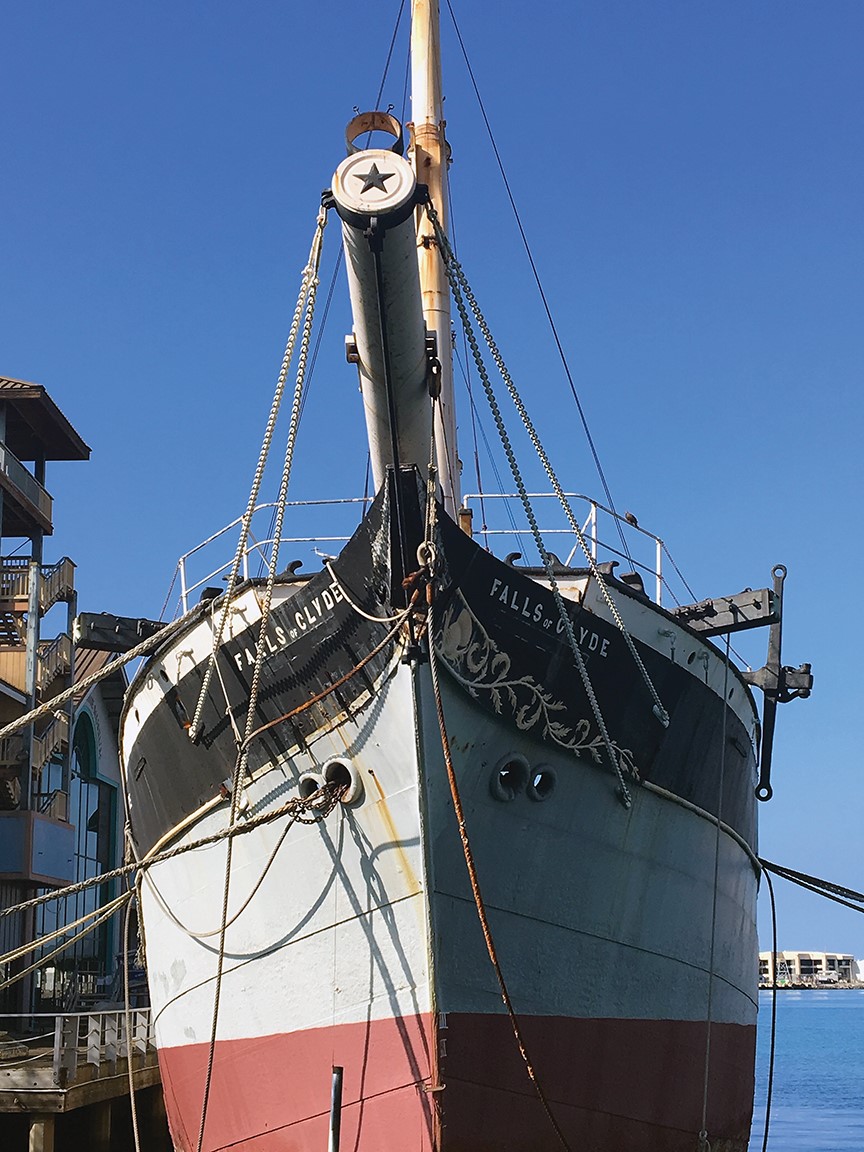
Falls of Clyde bow

Vessel docked in San Pedro, California

Falls of Clyde seen in Railroad Wharf, Hawaii

Vessel in Monterrey, California 1917

Falls of Clyde docked in Hawaii
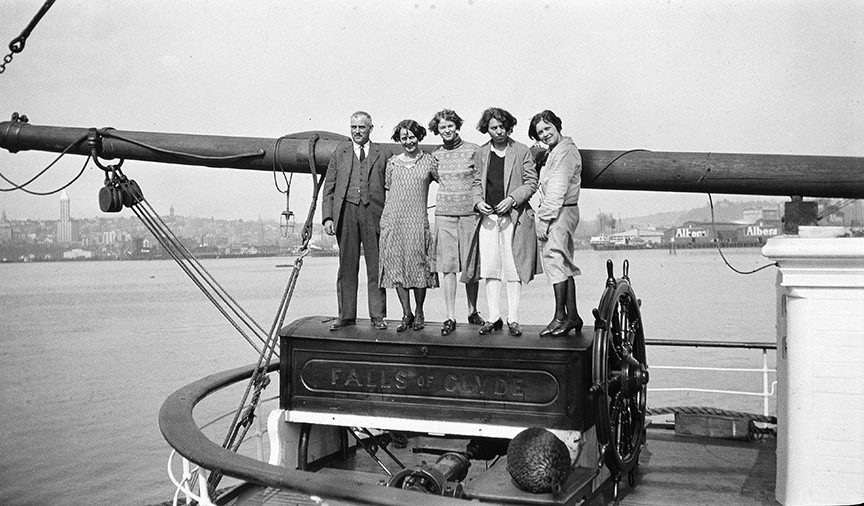
Passengers travel aboard